Muscovy duck
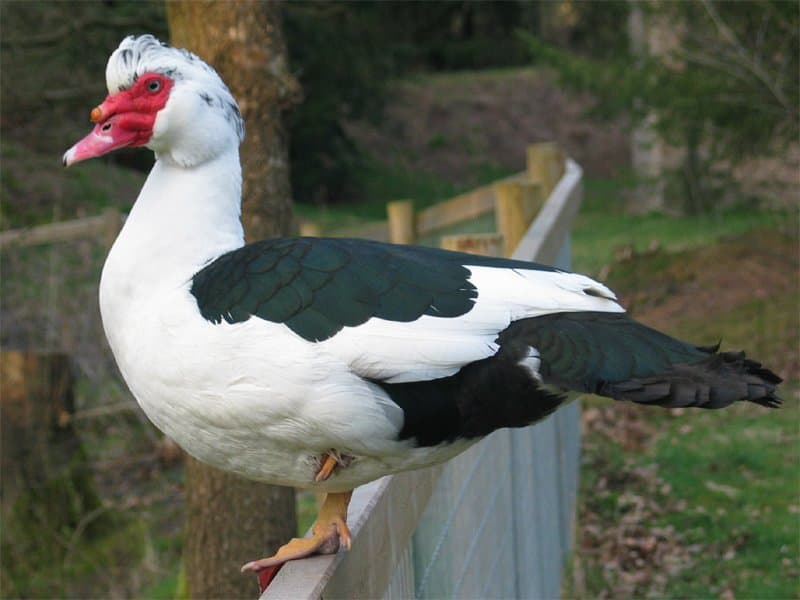
The Muscovy is a separate species (Cairina moschata), not a Mallard derivative. It is a heavy perching duck with red bare skin and caruncles on the face, and it is famous as a broody mother.
Some details are still being checked. Anything marked unconfirmed or reported may change. Suggest a change
The Muscovy is a pure-bred duck breed in the PCGB Heavy class. Its origin is given as Central and South America.
It is kept in heavy form. Recognised colours: Black Magpie, Blue, Blue Magpie, Chocolate, Chocolate Magpie, Lavender, Wild (Mainly Black), White. Typical adult weights: drake about 4.5–6 kg and duck about 2.5–3 kg.
Expect roughly 60–150 eggs a year, with white/cream shells. It is mainly kept for the table.
Compiled from poultryclub.org, domestic-waterfowl.co.uk, poultrykeeper.com, waterfowl.org.uk, en.wikipedia.org. See sources
Photos
From keepers' flocks
No keeper photos yet.
Keep this breed? Add your birds on Flockstock and share a photo from the bird's page. Go to my flock
Identity
- Species
- Duck
- Type
- Pure breed
- PCGB class
- Heavy
- Origin
- Central and South America
- Kept for
- Table
History
Wild Muscovies come from Central and South America. The domestic form was standardised in America in 1874 and in the British Waterfowl Standards in 1954.
Appearance
Heavy-bodied, low-slung and short-legged, with an erectile crest and red facial skin that grows warty caruncles with age, especially in drakes. Drakes weigh about 4.5–6.3 kg, roughly twice the weight of the ducks at 2.3–3.2 kg. Nine UK colours: Black (wild), Blue, Chocolate, Lavender, White and four Magpie patterns.
Recognised colours
Black Magpie, Blue, Blue Magpie, Chocolate, Chocolate Magpie, Lavender, Wild (Mainly Black), White
Size and weight
- Forms
- Heavy
- Drake
- 4.5–6 kg
- Duck
- 2.5–3 kg
Eggs
- Eggs a year
- 60–150
- Egg colour
- White/cream
- Notes
- No reliable annual egg figure was found in the sources.
Temperament
- In short
- Calm when domesticated
- Keeping notes
- BWA says domestic Muscovies are calm and that their reputation for aggression is largely unfair. A sitting duck will defend her young hard. Drakes give a low, breathy sound and ducks a quiet trill, so they suit noise-sensitive gardens (unconfirmed). Wild-type birds have long claws and fly well (unconfirmed).
Hardiness
Hardy (unconfirmed)
Broodiness
Excellent broody
Flying
Not recorded yet.
Suitability
- Good to know
- Muscovy crossed with a Mallard-type duck gives a sterile 'mule'. That is general knowledge rather than from these sources (unconfirmed).
Conservation status (RBST)
Not on the Rare Breeds Survival Trust's priority list.
Breed club
Sources
This page is compiled from:
Review
Some details are still being checked. In particular: hardiness; flying; mule note; noise note.
Suggest a change
Spotted something wrong or missing? Tell us what it should say, and we'll review it.