Magpie duck
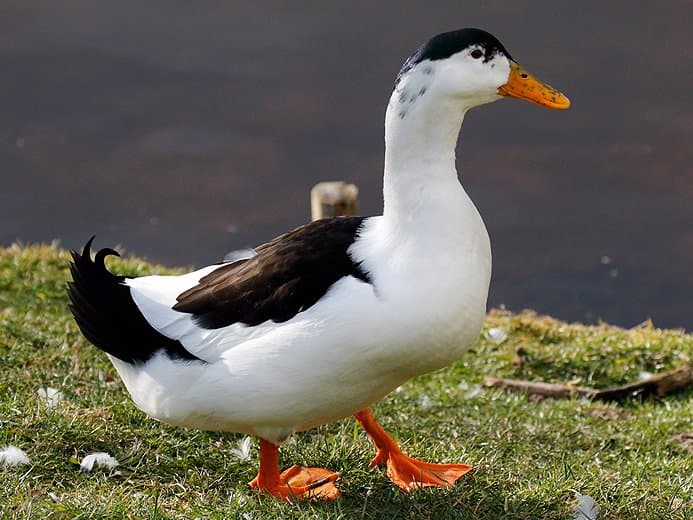
The Magpie is a Welsh-bred light duck, mainly white with a coloured cap and back. BWA describes it as active, very hardy and long-lived. It is on the RBST watchlist.
The Magpie is a pure-bred duck breed in the PCGB Light class. Its origin is given as Wales. It appears on the RBST Watchlist as a priority breed, so keepers of pure stock help conserve it.
It is kept in light form. Recognised colours: Black, White, Blue, Chocolate, Dun. Typical adult weights: drake about 2.5–3.2 kg and duck about 2–2.7 kg.
Expect roughly 80–180 eggs a year, with white/blue-green shells. It is mainly kept for the table and for exhibition or as an ornamental bird.
Compiled from poultryclub.org, rbst.org.uk, domestic-waterfowl.co.uk, poultrykeeper.com, waterfowl.org.uk, en.wikipedia.org. See sources
Photos
From keepers' flocks
No keeper photos yet.
Keep this breed? Add your birds on Flockstock and share a photo from the bird's page. Go to my flock
Identity
- Species
- Duck
- Type
- Pure breed
- PCGB class
- Light
- Origin
- Wales
- Kept for
- Table, Exhibition or ornamental
History
M.C. Gower-Williams in Wales and Oliver Drake in Yorkshire bred it after the First World War. It was first described in 1921, got a club and standard in 1926, and went to the USA in 1963. Black-and-white was the only PCGB colour until 1997, when blue-and-white and dun-and-white joined. Chocolate-and-white, developed in Germany, was added later.
Appearance
White with a crisp coloured cap and a heart-shaped back patch, with the tail matching. Four UK colours: black, blue, chocolate and dun, each with white.
Recognised colours
Black, White, Blue, Chocolate, Dun
Size and weight
- Forms
- Light
- Drake
- 2.5–3.2 kg
- Duck
- 2–2.7 kg
Eggs
- Eggs a year
- 80–180
- Egg colour
- White/blue-green
- Notes
- Wikipedia rates it a good layer of large eggs.
Temperament
- In short
- Active, characterful
- Keeping notes
- Developed for eggs and the table, but now mainly shown.
Hardiness
Very hardy
Broodiness
Not recorded yet.
Flying
Not recorded yet.
Suitability
- Good to know
- Symmetrical, sharp markings are hard to breed consistently.
Conservation status (RBST)
A priority breed on the Rare Breeds Survival Trust Watchlist.
Breed club
Sources
This page is compiled from:
Review
Nothing is flagged on this page at the moment. Breeds and strains vary, so check with a breeder or club too.
Suggest a change
Spotted something wrong or missing? Tell us what it should say, and we'll review it.