African goose
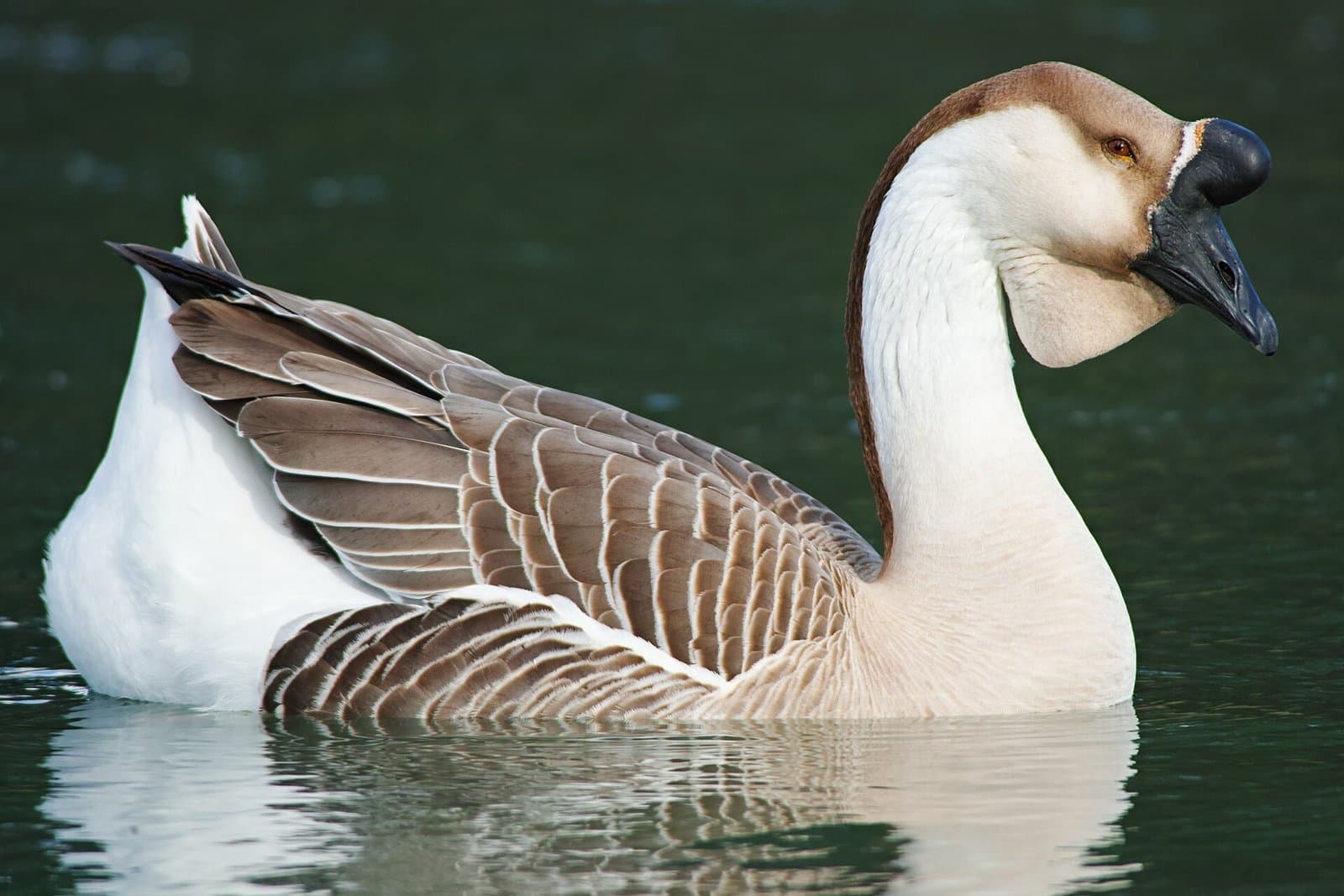
The African is a huge, upright goose with a knob on its bill and a crescent-shaped dewlap. It is among the heaviest of all goose breeds. Despite the name, it is Chinese in origin.
The African is a pure-bred goose breed in the PCGB Heavy class. Its origin is given as South China.
It is kept in heavy form. Recognised colours: Brown / Grey (most common), Buff, White. Typical adult weights: gander about 10–12.7 kg and goose about 8.2–10.9 kg.
Expect roughly 20–40 eggs a year, with white shells. It is mainly kept for the table.
Compiled from poultryclub.org, domestic-waterfowl.co.uk, poultrykeeper.com, waterfowl.org.uk, en.wikipedia.org. See sources
Photos
From keepers' flocks
No keeper photos yet.
Keep this breed? Add your birds on Flockstock and share a photo from the bird's page. Go to my flock
Identity
- Species
- Goose
- Type
- Pure breed
- PCGB class
- Heavy
- Origin
- South China
- Kept for
- Table
History
It descends from the wild Swan Goose (Anser cygnoides), as the Chinese goose does. All other domestic geese come from the Greylag. Wikipedia traces it to the Teochew/Swatow area of south China. Birds of this type were in Britain before 1700, possibly brought via Madagascar. America standardised the brown in its first Standard of 1874. Britain standardised Brown/Grey and White in 1982 and Buff in 1999.
Appearance
Exhibition birds reach about 12.7 kg and stand over 3 ft tall. The large head carries a stout bill, a knob and a dewlap, which can take 12–36 months to develop fully. The brown variety has a dark stripe down the back of the neck, a cream throat and ash-brown body feathers edged paler.
Recognised colours
Brown / Grey (most common), Buff, White
Size and weight
- Forms
- Heavy
- Gander
- 10–12.7 kg
- Goose
- 8.2–10.9 kg
Eggs
- Eggs a year
- 20–40
- Egg colour
- White
- Notes
- No reliable egg figure was found in the sources.
Temperament
- In short
- Bold, vocal; hand-reared birds tame
- Keeping notes
- BWA calls them bold and vocal. Hand-reared birds of the big exhibition strains make wonderful pets.
Hardiness
Not recorded yet.
Broodiness
Sometimes used as a broody
Flying
Not recorded yet.
Suitability
- Good to know
- Traditionally crossed with Toulouse for table birds. Sometimes used as a broody.
Conservation status (RBST)
Not on the Rare Breeds Survival Trust's priority list.
Breed club
- The Goose Club, umbrella · Website
Sources
This page is compiled from:
Review
Nothing is flagged on this page at the moment. Breeds and strains vary, so check with a breeder or club too.
Suggest a change
Spotted something wrong or missing? Tell us what it should say, and we'll review it.